IFSC Website Accessibility Audit Scope
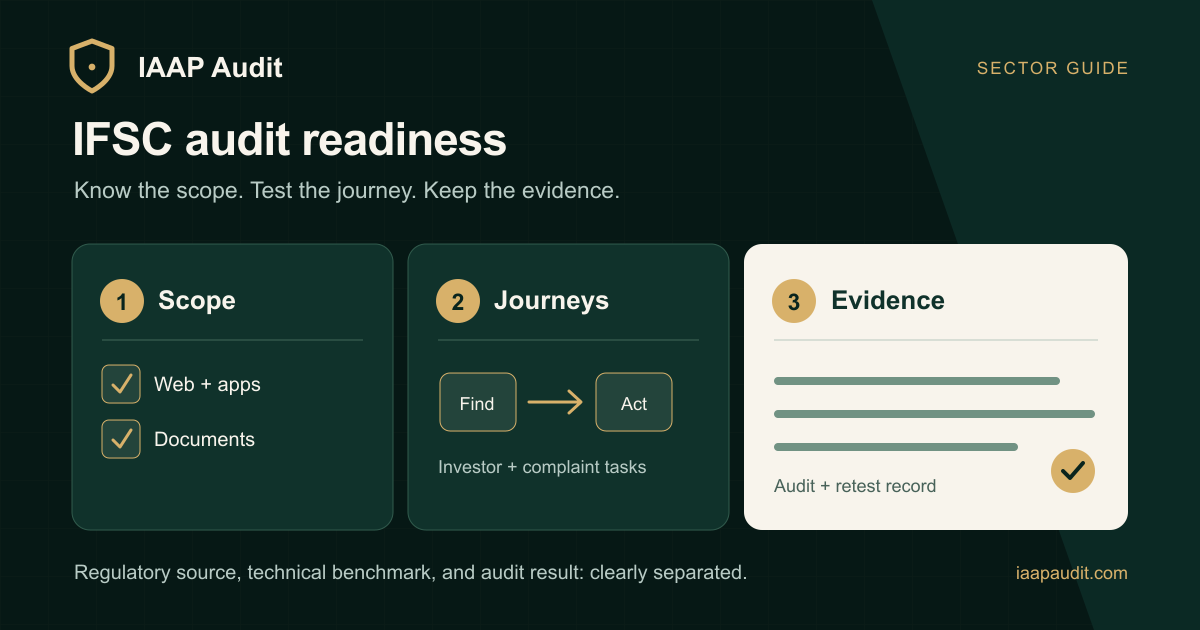
Turn an IFSC digital service into a testable accessibility scope
A team receives a request to “audit the website” and begins crawling public URLs. That may miss the important part: the investor uses a login flow, reads a PDF, enters details into a form, and reaches a confirmation screen. The scope needs to describe the journey rather than only the domain.
Here is a useful way to prepare the work for an IFSC entity.
Build a route and asset inventory
List public pages, authenticated portals, mobile screens, downloadable documents, embedded tools, and third-party steps. Add the task each asset supports and its owner. For a fund management entity, relevant publication pages can be identified from IFSCA's August 2026 website or webpage circular, which comes into force on December 1, 2026.
Keep the regulatory inventory separate from the accessibility inventory. The circular specifies what information must be available and where; it does not specify a WCAG conformance level. A link described as accessible from a group homepage is about discoverability, not a technical declaration that the linked page is accessible to assistive technology.
Choose representative states
For each journey, include more than the first screen. Test a valid submission, a missing required field, an invalid value, session timeout, document download, and confirmation where relevant. A crawler sees routes; it may not see the interaction barriers.
Document the chosen standard, such as WCAG 2.2 Level AA for web content, and record platform-specific test methods for apps and PDFs. Use manual keyboard and screen-reader checks alongside automated scans. Be explicit about authenticated test accounts and third-party limitations.
Turn findings into reproducible tickets
A good record contains the route, state, device, assistive technology, user task, observed barrier, WCAG mapping, and expected behavior. Keep publication defects separate: a missing contact is different from a contact link that cannot be reached.
Use a shared finding ID from discovery through remediation and retest. After a component fix, sample another page using the same component. For documents, inspect the produced download rather than assuming a template change fixed previously published files.
Avoid importing the wrong filing process
IFSCA and SEBI are different regulators. Do not build Table C3 or C4 submission logic into an IFSCA workflow unless an applicable direction requires it. A scoped audit can still produce detailed evidence the entity can use internally and for the obligations its compliance team confirms.
Read the original guide on IAAP Audit: https://iaapaudit.com/blog/ifsca-digital-accessibility-audit-readiness-guide
About the author
- IAAP Audit provides structured accessibility audit services for organizations that need evidence-led review of websites, web applications, mobile apps, PDFs, documents, design systems, and critical user journeys. Our audits are designed for compliance, procurement, governance, and remediation teams that need clear findings, standards mapping, severity grading, screenshots, selectors, remediation guidance, and retest evidence. Audit scopes can be mapped to WCAG 2.1 AA, WCAG 2.2 AA, IS 17802, GIGW, Section 508, and EN 301 549. We also support SEBI digital accessibility audit preparation, including C1 platform inventory, C3 initial audit reporting, C4 remediation/retest evidence, and report-ready documentation for agreed scopes. IAAP Audit works with financial services, SaaS, education, healthcare, e-commerce, public-sector vendors, and compliance-sensitive digital teams that need practical accessibility review without vague reporting. Our focus is simple: identify barriers, document evidence, prioritize risk, guide remediation, and help teams move toward more accessible digital services.
Comments
Join the discussionNo comments yet. Be the first to comment.